VIETNAM’S EXPERIENCE IN THE ENVIRONMENT AND DISASTER RESPONSE AT CAFEO 44
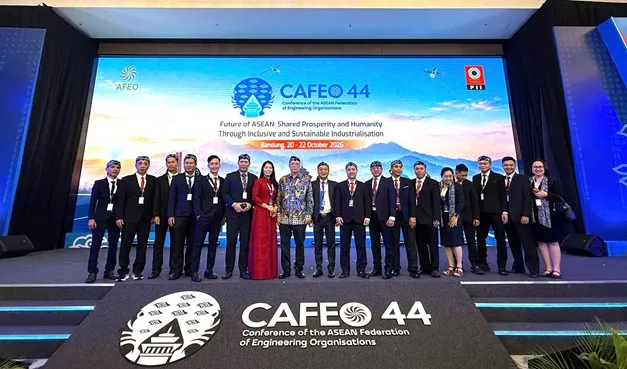
Joining two professional groups on environment and disasters at CAFEO 44, Mr. Pham Van Son – Director of the Vietnam Environmental Incident Response Center (SOS Centre), brings experience in resource management and pollution prevention from Vietnamese practices. The exchanges in Bandung show that many international lessons can be applied in the country, and at the same time open up opportunities for the experience of the SOS Center to be shared more widely in the region.
The 44th Conference of the ASEAN Federation of Engineering Organizations (CAFEO 44) will take place from October 20 to 22, 2026 in Bandung, Indonesia. According to the Vietnam Union of Science and Technology Associations (VUSTA), the opening ceremony gathered representatives of 11 AFEO member organizations and nearly 1,000 engineers from ASEAN and Korea. The Vietnamese delegation was led by Prof. VS. Chau Van Minh, Chairman of VUSTA.
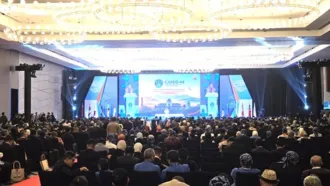
Overview of the conference CAFEO 44
On October 20 and 21, Pham Van Son, General Secretary of the Vietnam Association for the Protection of Nature and Environment (VACNE), Director of the Vietnam Environmental Incident Response Center (SOS), participated in the Environmental Engineering Group and the Disaster Preparedness Team. He also received the ASEAN Engineer Certificate in the field of environment at the conference.
Ready to respond before a call
A device listed in the inventory book is unlikely to be able to be brought to the scene right away. It may be in the process of being moved, in need of replacement parts, or not yet serviced. For rescuers, delays in detecting these things mean more time when the incident has already occurred.
That is the problem SOS must solve when the network grows to more than 300 response stations. At the Environmental Engineering Group, Mr. Son shared how to manage with digital maps, connecting information about the source of risk with the location and ability to mobilize forces. The power outage made the visual demonstration impossible to perform as planned, but how SOS maintains readiness was still communicated through the verbal presentation.
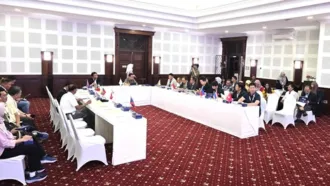
A working session of the Disaster Response Preparedness Group at the Geological Museum in Bandung, Indonesia, on October 21, 2026, held as part of CAFEO 44.
Accounting and warehouse data are connected to the management system to track where the equipment is and how much. Quarterly inspection and maintenance help determine whether the equipment is still in good working order or needs to be repaired; damaged and expired materials must be replaced. As a result, the operator has a basis to compare the data on the system with the actual resources at the station.
The distance to the scene should also be considered for the same type of equipment that can be mobilized. The nearest station is unlikely to have enough suitable facilities and supplies, because handling an acid spill is different from dealing with an oil spill. SOS also studies the sources of risk and pollution transmission in advance so that when receiving a call, it can quickly determine a response plan.
Chairman of the Environmental Engineering Group, Prof. Chin Lee Tuck (Brunei), noted the practicality of this approach and suggested organizing a webinar to share more widely the experience of SOS. The suggested time is December 2026. He paid special attention to the management of readiness, from equipment location, maintenance to organization of incident response.
Prevention of investment decisions
Many environmental risks can be limited if carefully calculated from the time of project selection. The rapid development of data centers in Malaysia poses the problem of electricity, water and cooling, as well as pressure on infrastructure and residential areas. This experience is noteworthy for Vietnamese localities that are attracting investment. In coastal areas, the value of carbon sequestration and shoreline protection of mangroves, through studies shared by Singapore, also needs to be taken into account when planning.
The effectiveness of a project also depends on what happens outside it. Bangkok is an example: water from upstream, local rain and high tides can put pressure on the city together. Adding reservoirs and pumping stations will be difficult to achieve effectiveness if rivers and canals still have tight sections or the operating agencies have not coordinated in time. To reduce flooding, it must be calculated throughout the basin, including areas outside the city limits.
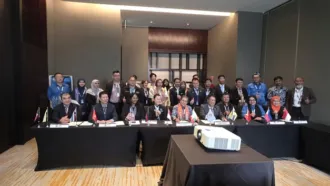
Delegates from the Environmental Engineering Group pose for a commemorative photo at the Pullman Hotel in Bandung, Indonesia, during CAFEO 44 on October 20, 2026.
With housing and essential works, Indonesia’s experience emphasizes the construction arrangement in accordance with the risks of each area, and strictly implements regulations to make the building resistant to earthquakes. The example of a hospital from the Philippines further clarifies this requirement: after an earthquake, the hospital still has to operate to treat victims. Therefore, the choice of technical solutions should be based on the function of the building and local conditions, avoiding the application of standard machinery of other countries as noted from Malaysia.
These lessons together raise questions about resource efficiency. As budgets increase and damage recurs, project selection and management responsibilities need to be reconsidered. Risk maps, models, and data provided by engineers should help determine exactly where to protect, what items to prioritize, and how to operate appropriately.
When floodwaters carry oil and chemicals
In the midst of discussions about the Bangkok flooding, Mr. Pham Van Son brought up another issue close to the rescue work in Vietnam: What will happen to petroleum depots, chemical depots and waste treatment facilities when the whole area is flooded?
Flood water can damage storage, wash away drums, chemical packaging and cause pollutants to spread to residential areas, production land, and water sources. When the water recedes, the consequences of pollution can be long-lasting. The difficulties in controlling transportation, storage and treatment of waste, shared by the Thai side in the answer, further show the importance of strictly managing these sources in advance.
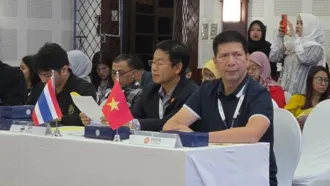
Mr. Pham Van Son – Director of the Environmental Response Incident Centre, attended the conference
From the experience of participating in responding to more than 300 environmental incidents, the SOS Center raises the issue of including the risk of pollution in the disaster prevention plan. Knowing in advance what facilities are in the flooded area, what substances are stored and where forces can be mobilized will help the preparation of the situation more closely. This is also the meeting point between the two professional groups that Vietnamese representatives participate in.
The Vietnamese representative’s proposal for a separate webinar for environmental incidents caused by natural disasters was positively received by the group. Members discussed how to arrange the topic in the joint program; the time and unit in charge will continue to be agreed. This direction of cooperation opens up more opportunities for Vietnam’s field experience to contribute to prevention work in the region.
Disaster preparedness needs to take into account oil, chemicals, and waste that can be released. Receding flood water does not mean that the environment is safe.
For experience to be shared in a timely manner
The Disaster Team Session at the Bandung Geological Museum also provided a different experience than the exchange in the conference room. Members learned about artifacts, earthquake and tsunami models and directly felt the vibrations in the simulation room. Technical knowledge became easier to visualize when associated with the situation that people could encounter, suggesting how to organize appropriate training in Vietnam.
However, useful experiences need to be exchanged more often than two meetings per year. At both groups, Mr. Son proposed to share the actual situation, photos, data and how to handle it as soon as the incident occurred, so that colleagues from other countries can refer to it in time.
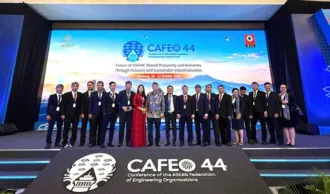
The Vietnamese delegation poses for a commemorative photo at the CAFEO 44 conference in Bandung, Indonesia.
A shared repository of documents being developed by the Disaster Team, along with expert databases and Environmental Group reports, can support that exchange. When gathered and qualitatively checked, data from multiple countries also help to study risk modeling, apply artificial intelligence and develop scientifically based recommendations.
With VUSTA, VACNE and partners of the SOS Center, the two working sessions opened up specific cooperation directions, from sharing rescue experiences to connecting experts and organizing training. Continuing to support Vietnamese focal points to participate in groups will help the exchanges in Bandung to be maintained. Thereby, international experience can be channeled into domestic work, while Vietnam’s effective practices have more opportunities to be known and developed by regional colleagues.
FROM CRITICAL COMMUNICATION TECHNOLOGY TO FIELD RESPONSE: HYTERA PARTNERS WITH SOS IN VIETNAM
In its efforts to document and share information regarding environmental incident response, the Vietnam Environmental Incident Response Center (SOS) has collaborated with Hytera to showcase professional operations, technological products, and applications used in incident response preparedness within Vietnam. A choice based on practical experience Hytera has collaborated with entities in various countries; for this particular […]
 Environmental news
22/09/2026
LESSONS FROM THE HORMUZ OIL TANKER INCIDENT: IMPLICATIONS FOR VIETNAM’S MARINE OIL SPILL PREPAREDNESS
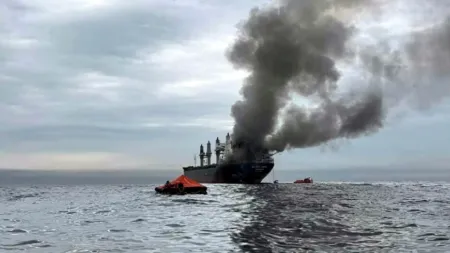
The recent oil tanker explosion in the Strait of Hormuz underscores the constant threat of marine pollution along global shipping lanes, where swift containment is vital to preventing ecological disater.
 Environmental news
05/10/2026
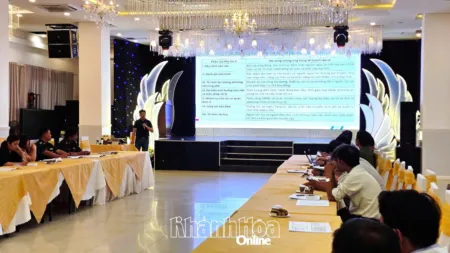
KHANH HOA ENHANCES OIL SPILL RESPONSE CAPACITY AND IMPLEMENTS DECISION 04/2026
Hội nghị tập huấn ứng phó sự cố tràn dầu năm 2026 tại Khánh Hòa tập trung vào việc cập nhật Quyết định 04/2026/QĐ-TTg, kiện toàn cơ chế phối hợp, hướng dẫn xây dựng kế hoạch và nâng cao khả năng sử dụng lực lượng, thiết bị trong thực tế. Trung tâm Ứng phó sự cố môi trường Việt Nam (SOS) tham gia tổ chức và chia sẻ các nội dung chuyên môn tại chương trình.