CONTROLLING PETROLEUM POLLUTION AT THE SOURCE: SIMPLE TECHNICAL SOLUTIONS AND STRONG GRASSROOTS OVERSIGHT NEEDED

Large-scale oil spills are not the only threat to ecosystems; minor, daily oil leaks and discharges from service facilities, storage depots, and watercraft constitute a silent yet massive cumulative source of pollution. This was emphasized by Mr. Pham Van Son, Director of the Vietnam Environment Incident Response Center (SOS Environment), during a talk show on solutions to mitigate petroleum pollution broadcast on VTV2 (Vietnam Television).
Daily Small-Scale Oil Pollution: High Cumulative Volume, Hard to Detect
According to Mr. Pham Van Son, over the same unit of time, the volume of oil leaked and discharged into the environment from routine daily operations is far greater than that from sudden, large-scale oil spill incidents.
On land, risks frequently arise from petrol stations, car wash facilities, mechanical repair and equipment maintenance shops, or the surfaces of storage depots. Without proper collection trenches and standard oil-water separators, spilled oil is carried by rainwater and wastewater directly into drainage systems and receiving water bodies.
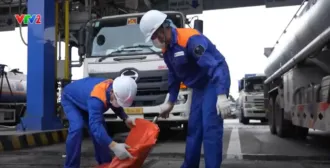
Oil spills occur at gas stations
On rivers, at sea, and at ports, many ports and inland water ways still lack centralized waste reception infrastructure. Oily bilge water in vessel engine rooms, deck spills, and refueling operations continue to pose risks of direct discharge into the environment. In particular, for fishing vessels and small watercraft, the management and reception of oily bilge water still face significant regulatory and operational gaps.
More concerningly, the most common fuel type in use today is diesel oil (DO) – a light, clear oil that easily mixes with water. Within just a few hours under the action of waves and currents, oil droplets disperse, bind to alluvial particles, and settle into sediment layers or remain suspended beneath the water’s surface, making late detection and source tracing extremely difficult for authorities.
Meanwhile, according to expert Do Thanh Bai, Chairman of the Vietnam Chemical Industry Responsible Care Council (VRCC), even a tiny amount of oil is enough to form a surface film that blocks dissolved oxygen and sunlight, impairing photosynthesis, harming plankton, and accumulating toxins up the food chain to humans.
Need for Practical, Cost-Effective Technical Solutions
Discussing measures to prevent pollution right at the source, the Director of SOS Environment noted that alongside legal regulations and penalties, the decisive factor is providing technical solutions that are simple, effective, and affordable for citizens and small-scale operators.
“If we only demand compliance or impose fines without offering practical solutions that fit into daily operations, citizens and small businesses will struggle to invest in overly expensive equipment. When solutions are simple and low-cost, compliance with environmental protection regulations becomes far more feasible,” Mr. Pham Van Son shared.

Mr. Pham Van Son – Director of the Vietnam Environmental Incident Response Center, speaking at the discussion forum
Practical deployment by SOS Environment shows that several on-site measures are delivering clear results: For watercraft and fishing vessels help placing specialized nano oil-absorbent materials (which absorb oil while repelling water) inside vessel bilges; once saturated, crew members collect the materials for proper hand over and treatment upon docking.
At storage depots, petrol stations, and drainage channels to installing oil-filtering fabrics along surface water drainage paths to trap oil droplets before runoff enters the environment.
At ports and fuel transfer areas may Deploying proactive containment booms prior to pumping and transfer operations to immediately isolate any potential leaks.
Strengthening the Role of Grassroots Authorities
Alongside technical measures, Mr. Pham Van Son highlighted the critical gatekeeping role of commune-level authorities the administrative level closest to local communities and small-scale production and service establishments.
To ensure prevention efforts are substantive rather than merely formalistic, specialized agencies and industry associations need to partner with local authorities to develop practical incident prevention and response plans, while stepping up training and awareness campaigns for grassroots officials, businesses, and residents.
Every drop of oil collected and controlled at the source not only reduces the risk of environmental incidents, but also helps sustainably protect water resources, ecosystems, and community livelihoods.
 Environmental news
27/11/2026
POLLUTION LOAD CONTROL AND INTER-REGIONAL RESPONSIBILITY
In water environment management, a key requirement is to accurately determine the assimilative capacity of a receiving water body and to control the quantity of pollutants discharged into it. In practice, assessing this capacity through a generalized, uniform approach may fail to detect instances where the threshold for specific individual pollutants has been exceeded. During […]
 Environmental news
07/11/2026
POLLUTION CONTROL AT SOURCE: AN IMPERATIVE DEMAND FROM INCIDENT RESPONSE PRACTICE
In environmental protection, remediating pollution after contaminants have widely dispersed is vastly more difficult and costly than controlling them directly at the source. Drawing from years of hands-on experience in environmental incident response, Mr. Pham Van Son – General Secretary of the Vietnam Association for Conservation of Nature and Environment (VACNE) and Director of the […]
 Environmental news
04/11/2026
BA SON CORPORATION AND VIETNAM ENVIRONMENTAL INCIDENT RESPONSE CENTER: PROACTIVE PREVENTION AND MAINTENANCE OF OIL SPILL RESPONSE CAPABILITIES
Industrial manufacturing, ship building, ship repair, mechanical fabrication, machinery and equipment operations, as well as maritime services, all harbor inherent risks of environmental incidents, including oil spills. Given the diverse nature of its operations, ensuring safety and environmental protection remains a top priority for Ba Son Corporation throughout its production and operational management. The SOS […]