CARGO SHIP SINKS OFF INDIA, FEARS OF SPILLING EXTREMELY TOXIC CHEMICALS INTO THE SEA
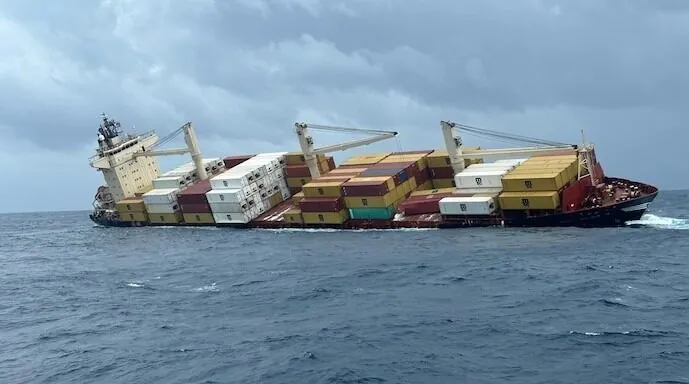
A cargo ship carrying 85 tons of diesel oil, 367 tons of fuel oil, and 12 containers of calcium carbide has just sunk 38 nautical miles off the city of Kochi (India).

According to India Today, on the morning of May 25, the Liberian-flagged cargo ship MSC ELSA 3 capsized and sank 38 nautical miles off the coast of the port city of Kochi (India).
The sunken ship was carrying 84.44 tons of diesel oil, 367.1 tons of fuel oil, and 640 containers. Of these, 13 containers contained dangerous goods and 12 containers contained calcium carbide – an industrial chemical that can cause severe water pollution if spilled into the sea.
All 24 sailors on board have been rescued by Indian rescue forces. However, concerns about the risk of a large-scale oil and chemical spill are still increasing by the hour. Calcium carbide (calcium carbide – CaC2) is a colorless solid, mainly used to produce acetylene gas (acetylene – C₂H₂), an important raw material in the chemical industry for synthesizing many different organic compounds.
A notable feature of calcium carbide is that it reacts strongly with water. When in contact, it undergoes a very high exothermic reaction, producing acetylene gas and calcium hydroxide (calcium hydroxide – Ca(OH)2). This reaction releases a lot of heat, and the acetylene gas produced is extremely flammable, causing a risk of explosion if not strictly controlled.
This type of gas also threatens to affect water quality, especially domestic water sources or agricultural water sources, especially when the shipwreck site is not far from the shore. In addition, the calcium hydroxide produced increases the alkalinity of the water, which can disrupt the pH balance, negatively impacting the health and fertility of the marine ecosystem.
The Indian Coast Guard (ICG) said it has deployed its pollution response vessel “Saksham” and is using aircraft equipped with advanced oil spill mapping technology to monitor the area.
According to the ICG, no oil spill has been reported so far. However, the situation is being closely monitored and is on standby, while salvage operations are ongoing in adverse weather conditions.
So far, authorities have also detected a number of containers drifting away from the wreck and are expected to wash ashore in the next few days.
The Kerala State Disaster Management Authority (KSDMA) has issued an urgent warning to the public, advising them not to touch or approach any containers or objects that may have washed ashore.
VIETNAM ENVIRONMENTAL INCIDENT RESPONSE CENTER
Address: P203 – A5, Thang Long International Village, Tran Dang Ninh street, Nghia Do ward, Hanoi.
Hotline: 1800 6558 – Email: sos@sosmoitruong.com
 Environmental news
22/10/2026
VIETNAM’S EXPERIENCE IN THE ENVIRONMENT AND DISASTER RESPONSE AT CAFEO 44
Joining two professional groups on environment and disasters at CAFEO 44, Mr. Pham Van Son – Director of the Vietnam Environmental Incident Response Center (SOS Centre), brings experience in resource management and pollution prevention from Vietnamese practices. The exchanges in Bandung show that many international lessons can be applied in the country, and at the […]
FROM CRITICAL COMMUNICATION TECHNOLOGY TO FIELD RESPONSE: HYTERA PARTNERS WITH SOS IN VIETNAM
In its efforts to document and share information regarding environmental incident response, the Vietnam Environmental Incident Response Center (SOS) has collaborated with Hytera to showcase professional operations, technological products, and applications used in incident response preparedness within Vietnam. A choice based on practical experience Hytera has collaborated with entities in various countries; for this particular […]
 Environmental news
22/09/2026
LESSONS FROM THE HORMUZ OIL TANKER INCIDENT: IMPLICATIONS FOR VIETNAM’S MARINE OIL SPILL PREPAREDNESS
The recent oil tanker explosion in the Strait of Hormuz underscores the constant threat of marine pollution along global shipping lanes, where swift containment is vital to preventing ecological disater.