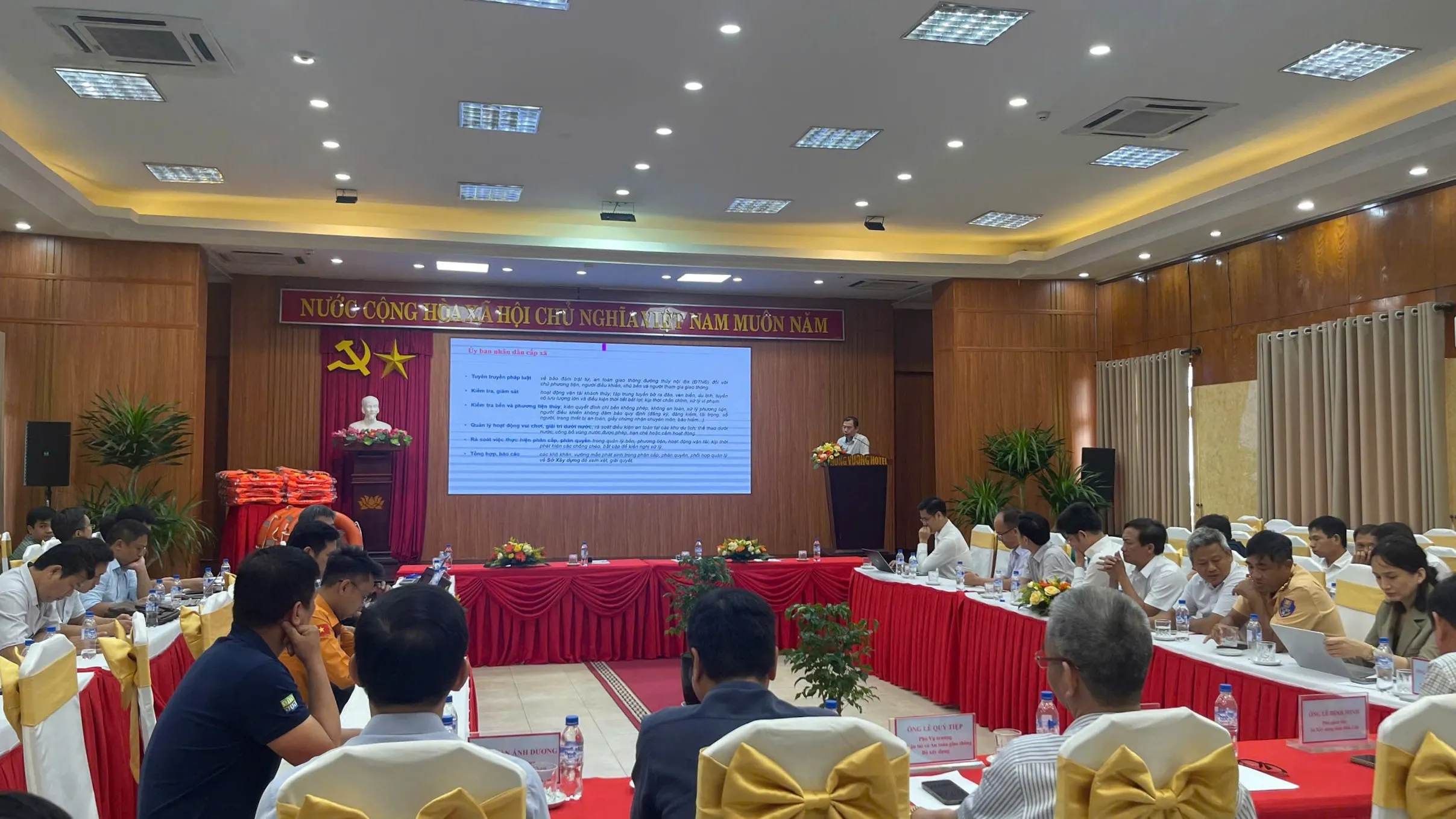
On October 30, a conference on the dissemination and implementation of legislation regarding inland waterway traffic safety in the Southern region took place in Quang Ngai Province. The event gathered representatives from state management agencies, industry experts, local authorities, and enterprises operating in the inland waterway sector.
Beyond core topics such as vessel management, crew licensing, and transport operations, the conference highlighted a critical area of concern: environmental risks arising from traffic accidents and routine vessel operations specifically, their potential threats to the environment and public health.
From Regulatory Requirements to On-Site Enforcement Capacity
The conference saw the participation of representatives from the Ministry of Construction, the Maritime and Inland Waterway Administration of Vietnam, the Vietnam Register, the Vietnam Maritime Search and Rescue Coordination Center (VMRCC), and the Vietnam Environmental Incident Response Center (SOS Center), along with leadership from Departments of Construction, port authorities, local regulatory bodies, and waterway transport enterprises from Da Nang to Ca Mau.
Overview of the conference
However, decentralization is only effective when paired with clear operational guidelines, data, management tools, and coordination mechanisms. Designated personnel must be fully equipped to detect violations, identify hazards, and manage emerging field situations within their jurisdictions.
The conference also updated participants on Circular No. 71/2026/TT-BXD dated September 17, 2026 (effective November 15, 2026), which focuses on simplifying and digitalizing procedures for testing, inspecting, issuing, and converting professional certificates. Additionally, delegates discussed practical challenges in vessel management, overload control, technical compliance, and transport operations across waterway routes.
Regulatory Gaps in Vessel Management and Pollution Control
According to reports presented at the conference, data verification identified approximately 72,216 inland waterway vessels across 34 provinces and cities. Freight vessels account for 66.6%, while passenger vessels represent 24.7%. Notably, only 38 registration units exist across 21 localities, leaving 13 localities without on-site registration facilities.
These figures underscore the need for continuous management enhancements, real-time status updates, and technical monitoring. This forms a vital pillar of risk prevention, as unmonitored vessels can become vulnerabilities in overall traffic safety.
From an environmental standpoint, risks extend beyond sudden accidents. Collisions, groundings, sinkings, or fires and explosions can release fuel oil, chemicals, and hazardous cargo into the water, soil, and air, endangering residential areas, aquaculture zones, water supply intakes, and sensitive ecosystems.
Furthermore, routine vessel operations generate ongoing pollution risks from oily bilge water, deck spills, and wash-water. Without proper collection, containment, and compliant transfer, these waste streams pose cumulative environmental impacts.
Mandating oil-water separators, slop tanks, and oily waste recovery equipment is essential; however, equipment installation is merely a prerequisite. Operational functionality must be field-verified alongside a reliable network of certified waste collection, transport, and treatment contractors. Lacking receiving facilities at ports and terminals makes seamless waste tracking from vessel to final disposal difficult to achieve.
Oil Spill Response Plans Must Reflect Real-World Capability
A key takeaway presented by the SOS Center was the imperative shift from paper-based compliance to verifiable field response capabilities.
Under Decision No. 04/2026/QD-TTg, applicable ports, facilities, and projects must formulate and execute Oil Spill Response Plans. Genuine capacity must be demonstrated through concrete factors: Equipment tailored to site-specific risks, personnel fully trained in deploying response assets, clear command structures, reliable mechanisms to mobilize professional response forces, and regular drills and training.
The SOS Center delivered a presentation at the conference
At the conference, the SOS Center proposed piloting an integrated management and response model at a high-risk port, terminal, or transport route. Under this framework, regulatory agencies, port operators, search and rescue forces, and environmental response units collaboratively map out risk sources, dispersion pathways, sensitive receptors, and deployable resources.
Concurrently, stakeholders must establish unified command and coordination protocols, conducting joint exercises for complex scenarios involving traffic accidents combined with oil spills or chemical leaks. Model effectiveness should be evaluated against key metrics: information intake speed, scene arrival time, personnel and equipment mobilization duration, sensitive area protection capability, and post-recovery waste reception and treatment plans.
Proactive Prevention to Safeguard Waterway Environments
The Quang Ngai conference successfully connected three closely linked pillars: Policy refinement requirements, practical management bottlenecks, and traffic safety risks tied to environmental pollution.
Drawing from experience in responding to over 300 environmental incidents, the SOS Center advocated for a holistic approach to waterway safety: moving beyond collision prevention to proactively identify pollution risks, prepare adequate resources, and validate cross-agency coordination capabilities before incidents occur.
Waterway traffic safety and environmental protection are not separate duties. Enhancing local management capacity, controlling vessel waste streams, and ensuring operational readiness will mitigate incident consequences, safeguarding water resources and aquatic ecosystems as inland waterway transport continues to expand.
 Environmental news
22/10/2026
 Environmental news
22/09/2026