WHEN FARMERS MASTER GREEN “TECHNOLOGY”
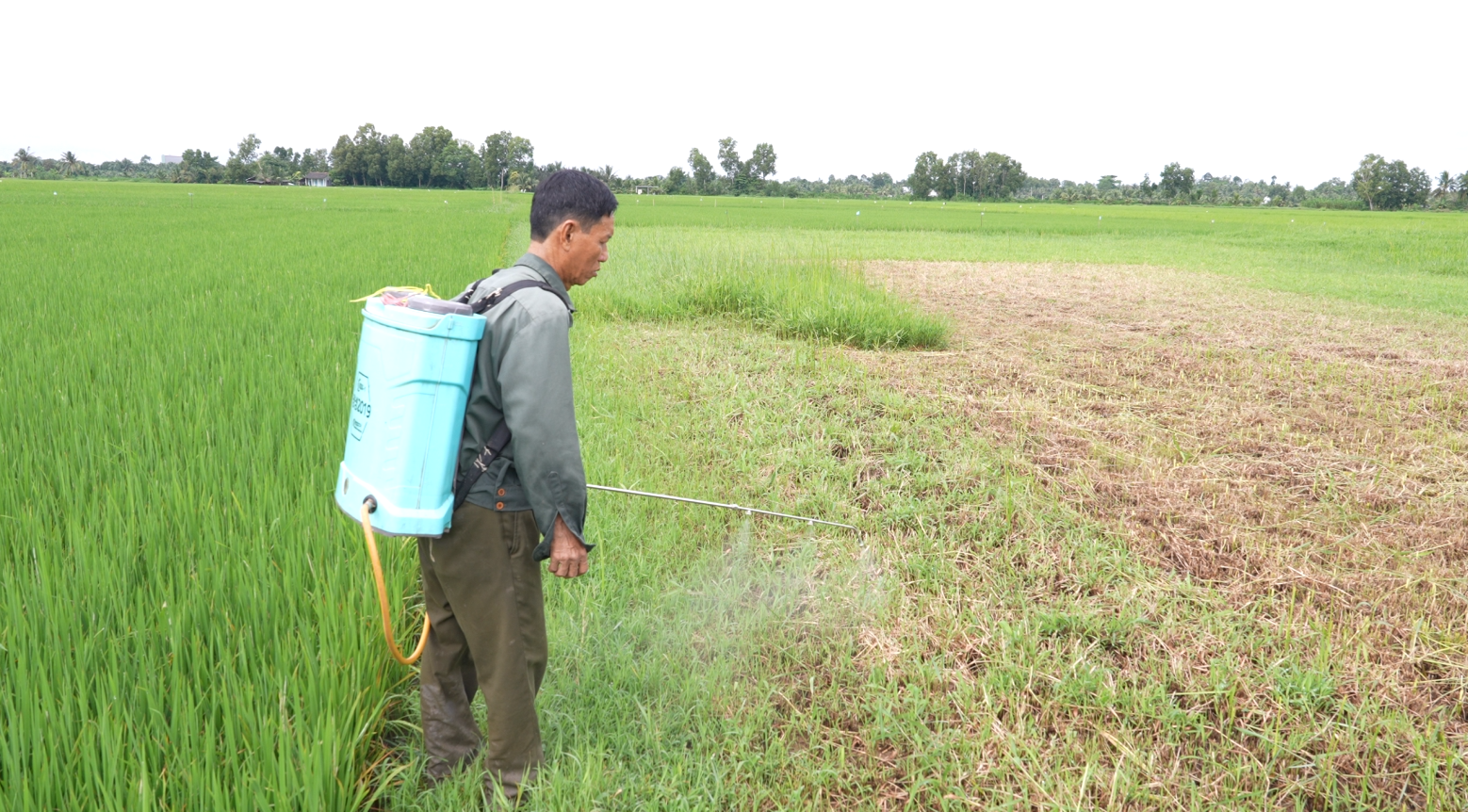
In Vinh Long, in the midst of the rice fields that are entering the new season, people have begun to get used to the image of farmers spraying microbes with a strangely confident appearance, this is the confidence of those who used to be skeptical, embarrassed, used to think that “burning copper is still the fastest”, but then they themselves became pioneers of the green agriculture model, thanks to a project supported by the GAHP (Global Alliance for Health and Pollution), funded by the UK Government through the Ministry of Environment, Food and Rural Affairs (Defra), in collaboration with the Vietnam Association for Nature and Environment Protection and Nguyen Tat Thanh University.
It’s no longer a story of engineering, it’s a story of mindset change. And that change, starting from very ordinary things.
Removing “chemicals” to switch to microorganisms
Mr. Le Van Hung, a voter of hamlet 1, Quoi An commune, said that until now, he has always been familiar with products such as herbicides, pesticides, pesticides and chemical fertilizers,… as well as never had access to the new direction of microbiology for rice.
After being mobilized by the hamlet to participate in a training class on the post-harvest straw treatment model, as well as being assigned 9000m2 of pilot land and the corresponding amount of microbial preparations, he embarked on the implementation. In the first case, he only dared to use 50% of the supported microorganisms, partly because he was afraid of spraying the wrong dosage as instructed, partly because he was still skeptical about “is it better than pesticides?”
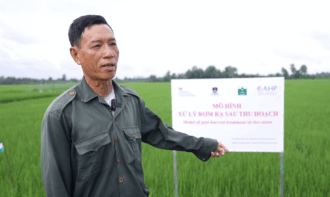
Mr. Le Van Hung, a voter of hamlet 1, Quoi An commune – Vinh Long gave up pesticides to switch to using microorganisms
“The microorganisms were a little too thick at first, I had to use my hands to remove each plastic lump to dilute it. The difficulty is that you can’t spray according to the engineer’s instructions at the wrong dose,” he recalled, laughing and admitting that he was embarrassed at the time because of the “new technology”. But then the “green” field answered for his worries.
Just a few days after spraying, he saw something that plowing and burying straw had never done before: The straw was decomposed and decayed in a short time; there is no longer root rot; the young rice grows evenly, does not die, breaks scattered; the rice has decreased sharply, as well as the soil is noticeably “opener” when stepping into the field.
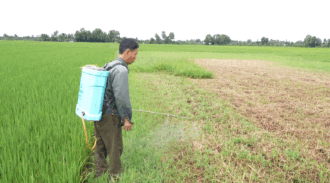
Mr. Hung uses microbiology for rice stumps to treat rice straw for the new season
“There are half the microorganisms that the field is doing well, I’m glad to know,” he said. Then he carefully stored the remaining 50% of the microorganisms for the next crop. Not because of regret, but because he believed that this was what helped him take the initiative in both the land and the crop. When asked if he would buy microorganisms when he ran out of support, he nodded and replied: “Even if I use up all the microorganisms this time, I will buy them for further use in the future, completely replacing pesticides. It saves costs, increases rice yields, and straw treatment is much more compact than fertilizer.”
That is the first sign of farmers “mastering technology”, no longer waiting for support, but knowing how to actively invest.
People who used to bury straw to the point of exhaustion, now look at the straw “soft” thanks to microorganisms
Not far away, Mr. Dang Van Tam, also belonging to hamlet 1, has gone through almost all ways of treating straw: Burying straw, collecting straw for cows, drying straw to grow mushrooms… As for burning straw, he said that he “burns less because the straw is not enough to burn”. However, his farmland is always in the same condition: Degraded land, stunted rice, red stems; ghost rice and upside down rice grow on tendrils; pests and diseases clinging to each crop; fertilizers are expensive but not very effective…
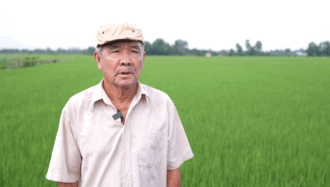
Mr. Dang Van Tam – Farmer of hamlet 1, Quoi An commune – Vinh Long feels more secure after a period of using microbiology
“Many times after sowing, I feel discouraged when I look at the field. The rice grows like there is a lack of milk,” he described with the sincerity of a year-round farmer. In this case, for the first time, he sprayed microbiology according to the instructions of the GAHP-VACNE project and a group of students from Nguyen Tat Thanh University and the results came faster than his skepticism: The straw was decomposed and treated right in the season; rolling rice has only a few sparse stalks; pests “disappear”; green rice returns to the correct color of “healthy rice”.
“It’s easy to do. I went to visit the fields, saw that the straw was all over, the rice was green, I just said, so for the past few years, I have been plowing and burying the straw in vain?” – Mr. Tam shared. This saying, which sounds very simple, reflects an important turning point: Farmers no longer “follow the habit” as before, but begin to actively question what they have been accustomed to for many years, from how to handle straw to cultivate each crop… It was the moment they wondered “Is there a better way?” that opened the door to a drastic and sustainable change in the mindset of production.
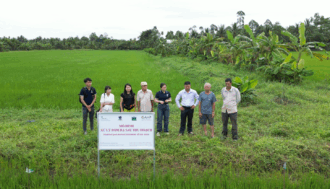
GAHP’s straw treatment model collaborates with VACNE to pilot for farmers in Vinh Long
Young people behind “green technology”
Behind these successful straw treatment models, there is a group of young PhD students who are both knowledgeable about science and empathetic to rural life. Dang Thi Ngoc Mai, a PhD student at Nguyen Tat Thanh University, said that when studying biology and environment, she learned the truth that: Burning straw harms the lungs, heart, and eyes; failing to kill pathogens as farmers believe; and inadvertently destroy beneficial microorganisms in the soil, causing the soil to lose organic matter and leading to root poisoning.
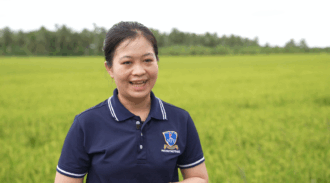
Dang Thi Ngoc Mai – PhD student at Nguyen Tat Thanh University (Ho Chi Minh City)
That is why she participated in the research of microbial preparations to support the GAHP-VACNE project to implement a green agriculture model. From “a viewer burning straw for fun”, Ngoc Mai has become the one who knocks on the door of each farmer’s house, persuading them to give up the habit that has lasted for decades. For her, the first stage of encouraging farmers to change their mindset was quite difficult, because they were used to burning fields as “cleaning the field quickly, clean of pests and diseases”, when they asked them to try microbiology, they did not believe it and did not want to try.
But “fire tests gold, hardships test strength”, finally after many persuasive efforts, through training classes for farmers, the first experimental crop was rewarded with worthy results. With only 6 fields, farmers have seen the potentials that microorganisms bring: No more organic poisoning; ghost rice and upside down rice have decreased significantly; the soil is loose, easy to make… and especially increase a stable source of income for farmers.
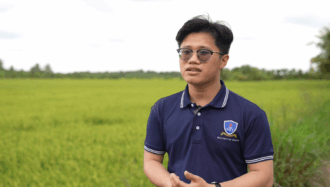
Tran Vu Hoai An – PhD student at Nguyen Tat Thanh University (Ho Chi Minh City)
For Tran Vu Hoai An, who is also a PhD student participating in the GAHP-VACNE project, he sees green agriculture from a more long-term perspective: It is the vital future of the rice growing area. He shared, when supporting farmers in hamlet 1, Hoai An has witnessed long-term chemical fields being worn out; green rice does not float because the soil is no longer nutritious; productivity decreases but costs increase.
However, after only a period of using microorganisms for rice, farmers saw an increase in yield, strong green rice, clean decomposing straw… It was even noted that the situation after farmers used microorganisms had reduced ghost rice by 70-80% and completely decomposed the straw roots. From there, it is also possible to completely reduce the work of harvesting ghost rice, herbicides, input costs to buy fertilizers, herbicides or pesticides,…
This is living proof that GAHP-VACNE has put “green technology” where it is needed most. And when thinking changes, so does action. Today, in Quoi An, Mr. Hung still keeps 50% of the microbial cans in the corner of the house to prepare for the next crop. Mr. Tam still went to the field to check the melted straw after a few days of spraying. And the group of young students continued to enjoy the sunny day with their relatives, perfecting each microbiological formula better. And that’s when they become inspirational people, not just farmers.
SOS
 Environmental news
28/11/2025
Environmental news
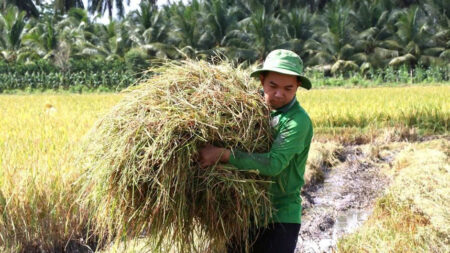
28/11/2025THERE ARE MICROORGANISMS IN THE FIELD, RICE IS “GREEN” AFTER HARVEST
In the context of rice production under pressure from climate change (climate change) and increasing material costs, the model of treating rice straw with microbial products in the field by the Global Alliance for Health and Pollution (GAHP), in collaboration with the Vietnam Association for the Protection of Nature and Environment (VACNE) has been implemented […]
 Environmental news,SOS Environment's activities
20/11/2025
Environmental news,SOS Environment's activities
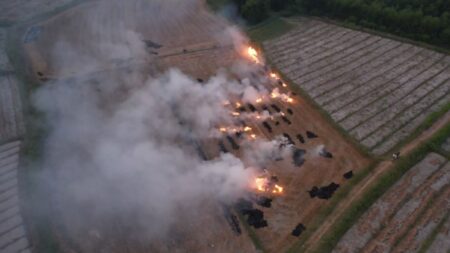
20/11/2025WHEN THE HARVEST SEASON TURNS INTO THE “SMOKE SEASON”: WHY DOES THE BURNING OF RICE STRAW STILL LAST?
According to environmental experts, behind the smog pollution caused by straw burning is a chain of deep causes coming from traditional farming practices, gaps in support policies, difficulties in the economy, equipment, and lack of synchronization in law enforcement,… Every year, at the peak of the harvest season, the suburbs of Hanoi and the Northern […]
 Environmental news,SOS Environment's activities
20/11/2025
Environmental news,SOS Environment's activities
20/11/2025BEHIND THE WHITE SMOKE: THE “SILENT” AGENT OF AIR POLLUTION
When it comes to air pollution, we often think of car smoke, smoke from factory chimneys, or dust from construction projects,… However, behind that conspicuous white smoke, there is a “silent agent” that is quietly covering the atmosphere, which is the burning of straw harvested after each harvest. This seemingly harmless activity produces large amounts […]