SCALING UP THE GREEN AGRICULTURE MODEL: LESSONS FROM THOSE WHO SUCCEEDED

After the project “Air Pollution and Open Burning in Agriculture in Vietnam,” implemented by GAHP in collaboration with VACNE with funding from Defra, alternative models to open burning in agriculture in Vietnam have demonstrated that rice straw is not “waste” that needs to be discarded, but rather a resource capable of generating economic and environmental value. From the initial pilot models, many practical lessons are emerging that open pathways for scaling up across the country.
From agricultural by-products to new resources
Vietnam is one of the world’s largest rice-producing countries, with the amount of rice straw generated each year estimated at about 45-50 million tons. However, most of this by-product resource has not been used effectively; about 80% of the straw is wasted or burned directly in the fields, causing resource waste and greenhouse gas emissions.

The project is being piloted in provinces and cities across Vietnam to help farmers handle rice straw scientifically.
In recent years, many models for processing rice straw according to a circular economy approach have been implemented in localities such as Vinh Long, Ninh Binh, Dong Nai, An Giang, and the Mekong Delta region. Instead of burning it, rice straw is treated with microorganisms and used as organic fertilizer, for mushroom cultivation, or for producing biomass pellets. These solutions not only help reduce environmental pollution but also create new sources of income for farmers.
According to Mr. Nguyen Duy Binh – Director of Lam Son Environmental Sanitation Joint Stock Company, rice straw can completely become an important raw material for bioenergy production. In some localities, rice straw after harvest is collected to produce biomass pellets, a type of clean fuel that can partially replace coal or oil in industry.

Straw is utilized to produce biomass pellets
“Straw used to be considered a discarded by-product, but if it is collected and processed properly, it becomes a very large raw material source for the circular economy in agriculture,” Mr. Binh said.
Agricultural studies also indicate that utilizing straw can bring many benefits such as: improving soil structure, increasing organic matter content, reducing the use of chemical fertilizers, and lowering greenhouse gas emissions in rice production.
Successful models from practice
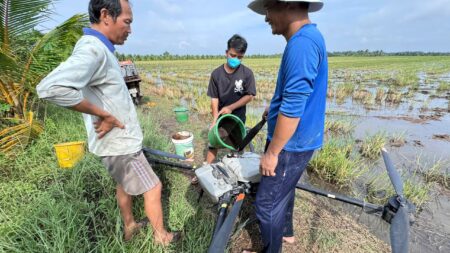
One notable approach is the model of treating straw with microbial preparations directly in the fields. After harvest, the straw is left on the field and treated with microorganisms so that it decomposes quickly, becoming an organic nutrient source for the soil.
In An Truong commune, Tra Vinh province, Mr. Duong Van Cao – a farmer participating in the low-emission rice cultivation model is one of the pioneers applying this method. Previously, his family, like many other households, often burned straw after each harvest to clear the field quickly. However, after joining the straw treatment model using microorganisms, he noticed many positive changes.

Mr. Duong Van Cao – Head of the Farmers’ Association Chapter of An Thanh hamlet (An Truong, Vinh Long) – together with experts shared how to implement the model in the fields.
According to Mr. Cao, after a period of application, the rice field soil becomes looser and more aerated, with less organic toxicity. The rice plants grow stronger and more uniformly. At the same time, the amount of chemical fertilizers and crop protection chemicals has also decreased significantly compared to before. “In the past, we thought rice straw had to be burned to clean the fields, but when treated with microorganisms, the straw decomposes quickly and the soil becomes better. Production costs are also reduced, so people gradually trust it and follow the method,” Mr. Cao shared.
Also participating in the model locally, Mr. Dang Van Tam – a farmer in Quoi An commune, Vinh Long (formerly Tra Vinh) – has also observed clear changes after applying the technique of treating rice straw with microorganisms. According to Mr. Tam, this method helps limit pests and diseases, reduce the amount of chemical fertilizers, and improve the quality of cultivated soil. “After a few crop seasons applying it, the rice fields are healthier, the soil is softer, and there are fewer pests and diseases. Costs decrease while yields remain stable, so people are very pleased,” Mr. Tam said.
The practical results from the fields have gradually encouraged many farmers in the region to change their farming habits. From initial skepticism, more and more households are now willing to adopt environmentally friendly rice straw treatment solutions.
Not only at the household level, these models have also received support and wider promotion from local authorities. Mr. Tran Van Phong – Head of the People’s Committee of An Thanh hamlet, An Truong commune, Vinh Long said that changing the habit of burning rice straw requires time and persistence. At first, people were hesitant because they were unfamiliar with the new technique. But after seeing the effectiveness in the fields of pioneering households such as Mr. Cao and Mr. Tam, many others have begun to follow.

Project to expand training and capacity-building classes for farmers in localities
A common factor behind the project’s successful models is the active participation of farmers. Instead of being merely beneficiaries, farmers become the ones who directly experiment with, improve, and spread green farming solutions. In many localities, training courses, workshops, and demonstration models have helped farmers access new techniques. When they see real results on their own fields lower costs, healthier soil, and stable yields people become willing to change their traditional farming practices.
In particular, the role of rural women has also been recognized as an important factor in this transition process. In many areas, women not only participate in production but are also active in community communication activities, encouraging others to adopt environmentally friendly rice straw treatment solutions.
From the practical implementation in many localities, experts believe that expanding green agriculture models should be based on several important lessons. First, solutions must be suitable for the actual production conditions of farmers. If the technology is too complex or the costs are too high, it will be difficult for people to apply it in the long term. Successful models all share common features: They are simple, easy to apply, and bring clear economic benefits.

Rural women are also a key factor in the spread of the project.
Accordingly, there needs to be a connection between science, government, and the community. Research institutes and experts provide technical solutions; local authorities support policies and organize implementation; while farmers are the ones who directly apply and spread the model.
At the same time, communication and training play an important role. Changing a long-standing farming habit cannot happen in a short time. Organizing training sessions, community communication, and building real demonstration models help people clearly understand the benefits and feel confident in applying them.
Finally, it is necessary to develop value chains from agricultural by-products. When straw can become a source of raw material for products such as organic fertilizer, straw mushrooms, or biomass pellets, farmers will have strong motivation to change the habit of burning straw. Results from pilot models show that handling straw in a circular economy approach is entirely feasible in Vietnam. However, for these models to be replicated more widely, coordinated support from many stakeholders is needed.

Authorities and local governments need to improve institutions and policies to create a sustainable foundation that supports agricultural development for farmers.
First of all, localities need to develop policies that encourage farmers to adopt environmentally friendly rice straw treatment solutions, such as providing technical support, training, or connecting markets for products made from agricultural by-products.
In addition, it is necessary to promote the participation of businesses in the rice straw value chain, from collection and transportation to processing into valuable products such as biomass pellets or organic fertilizer.
In the context of Vietnam promoting the goal of developing green agriculture and reducing greenhouse gas emissions, utilizing agricultural by-products such as rice straw is considered an important solution. Successful models in localities show that when science, policy, and the community work together, positive changes can absolutely begin right from the fields themselves.

Green transition models need to be replicated and spread so that Vietnam becomes increasingly prosperous.
From rice fields no longer filled with smoke after harvest, a new direction for sustainable agriculture is gradually taking shape. And the lessons from today’s pioneering farmers are the very foundation for green agricultural models to continue being expanded in the future.
SOS
 Environmental news
02/03/2026
Environmental news
02/03/2026INTERNATIONAL EXPERTS DISCUSS SOLUTIONS TO CONTROL POLLUTION IN SOUTHEAST ASIA
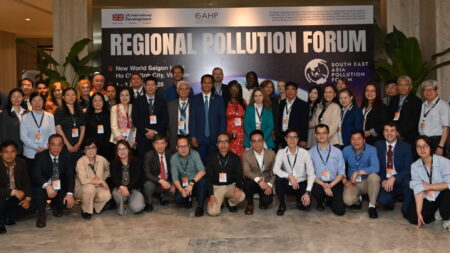
On the morning of March 2, 2026, in Ho Chi Minh City, the Vietnam Association for Conservation of Nature and Environment (VACNE), in coordination with the Global Alliance on Health and Pollution (GAHP), organized the Regional Pollution Forum (RPF) with the theme “Addressing Pollution to Improve Community Health.” The forum took place over two days, […]
 Environmental news
04/03/2026
Environmental news
04/03/2026INTERNATIONAL WORKSHOP SUMMARIZING THE PROJECT “AIR POLLUTION AND OPEN BURNING IN AGRICULTURE IN VIETNAM”
On the morning of March 4, 2026, in Ho Chi Minh City, with the support and permission of the Ministry of Agriculture and Environment, the Vietnam Association for Conservation of Nature and Environment (VACNE) coordinated with partners to organize the International Workshop summarizing the project “Air Pollution and Open Burning in Agriculture in Vietnam.” The […]
 Environmental news
06/03/2026
Environmental news
06/03/2026FROM SMOKE AND DUST TO A “CLEAR” SKY
Burning rice straw after harvest used to be a common practice in many rural areas of Vietnam, but it causes numerous environmental and health consequences. Since 2022, the model “limiting open burning of agricultural residues” has been piloted by the Global Alliance on Health and Pollution (GAHP), in coordination with the Vietnam Association for Conservation […]