INTERNATIONAL WORKSHOP SUMMARIZING THE PROJECT “AIR POLLUTION AND OPEN BURNING IN AGRICULTURE IN VIETNAM”

On the morning of March 4, 2026, in Ho Chi Minh City, with the support and permission of the Ministry of Agriculture and Environment, the Vietnam Association for Conservation of Nature and Environment (VACNE) coordinated with partners to organize the International Workshop summarizing the project “Air Pollution and Open Burning in Agriculture in Vietnam.”
The conference was held in a hybrid format combining in-person and online participation, connecting locations in Hanoi, Ho Chi Minh City, Hue, and many other localities, attracting more than 120 scientists, managers, and environmental experts from both within the country and abroad.
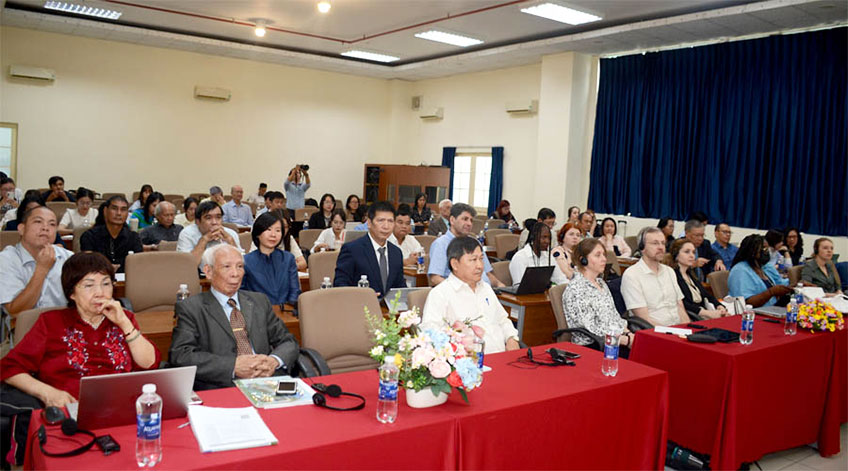
A large number of delegates attended the workshop in person in Ho Chi Minh City.
The project has been implemented by VACNE since 2022, with funding from the UK Department for Environment, Food and Rural Affairs (DEFRA) through the Global Alliance on Health and Pollution (GAHP). The overarching objective of the project is to comprehensively assess the current situation of open burning of agricultural residues and the use of plant protection chemicals; at the same time, to propose solutions to reduce impacts on air quality, human health, biodiversity, and climate change in Vietnam.
Attending the workshop were Ms. Adetokunbo Adekunbi Folasade Akinseye – Director of the International Centre on Chemicals, Pesticides and Hazardous Waste, Head of the DEFRA delegation; Ms. Maria Paola Lia – Executive Director of GAHP, along with many international experts. Representing VACNE were Dr. Nguyen Ngoc Sinh – President of the Association; Prof. Dr. Dang Huy Huynh – Vice President of the Association and Head of the Project Steering Committee; together with Vice Presidents Prof. Dr. Tran Hieu Nhue, Prof. Dr. Dang Kim Chi, Assoc. Prof. Dr. Phung Chi Sy, and many scientists attending both in person and online.
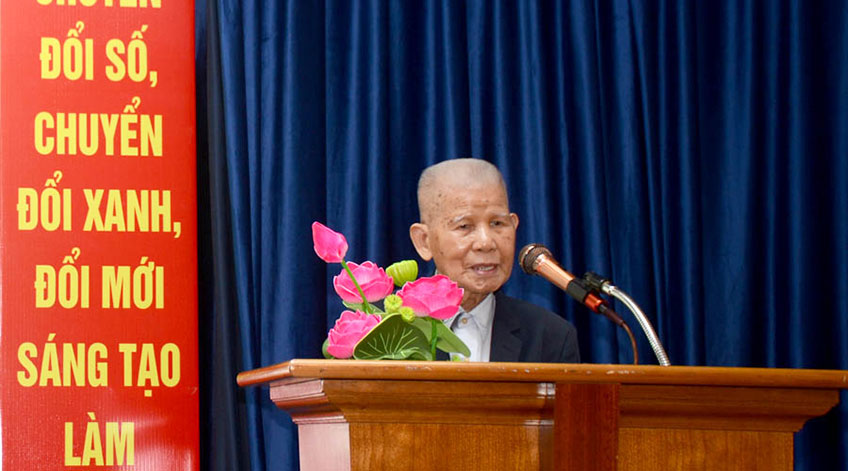
Prof. Dr. Sci. Dang Huy Huynh, Head of the Project Steering Committee, delivered the opening remarks of the Workshop
In his opening speech, Prof. Dr. Sci. Dang Huy Huynh, on behalf of the leadership of VACNE, extended a warm welcome to delegates from both Vietnam and abroad, while emphasizing the significance of the workshop being held in the early days of spring – a time that marks new commitments and actions for the environment. He expressed deep gratitude to DEFRA, GAHP, and partners who have accompanied the project over the past four years, as well as more than 150 scientists and experts who have contributed their knowledge and dedication to the project. According to him, the achievements attained are clear evidence of the effectiveness of international cooperation based on scientific foundations and community responsibility.
In the project’s summary report, Assoc. Prof. Dr. Phung Chi Sy – Project Director presented a comprehensive overview of the key results with the participation of 25 organizations across the country. The project has established an important database system and scientific evidence on the current situation of open burning of agricultural residues and the use of plant protection chemicals; analyzed the relationships between air pollution, climate change, biodiversity loss, and human health; and proposed an impact assessment framework and policy orientations suitable to Vietnam’s conditions.
A notable highlight was the research and piloting of alternatives to open burning of rice straw. The rapid straw decomposition model in An Trường Commune and Quoi An Commune (Vinh Long Province), each covering 50 hectares, has initially shown clear effectiveness in improving soil quality and reducing emissions. The activity of collecting rice straw to produce RDF fuel pellets at Gia Binh Hong Ngu Joint Stock Company (about 40 tons) opens prospects for developing a circular economy, increasing biomass value, and reducing resource waste.
The project also completed a process for mapping “hotspots” of open rice straw burning nationwide; developed distribution maps by month and year; forecast PM2.5 concentrations generated in 2025; and assessed the contribution of rice straw burning to fine particulate pollution in Hanoi. Biomass surveys, estimation of burned quantities, and greenhouse gas emissions were conducted systematically, creating a scientific foundation for improving management policies.
Notably, the project designed and installed two automatic monitoring devices for PM1, PM2.5, PM10, and TSP indicators using solar energy, transmitting data online in several communes in Vĩnh Long Province. This system enables monitoring of air quality before, during, and after rice straw burning activities, providing empirical evidence of the impacts of open burning on air quality and community health.
Alongside research activities, communication and awareness-raising efforts were strongly implemented through training courses for managers, students, and farmers; publication of technical guidance materials; and articles on scientific journals and specialized websites. In particular, the “Green Fields – Clean Air” competition created a positive ripple effect, encouraging people to apply environmentally friendly farming practices, limit rice straw burning, and reduce the improper use of plant protection chemicals.

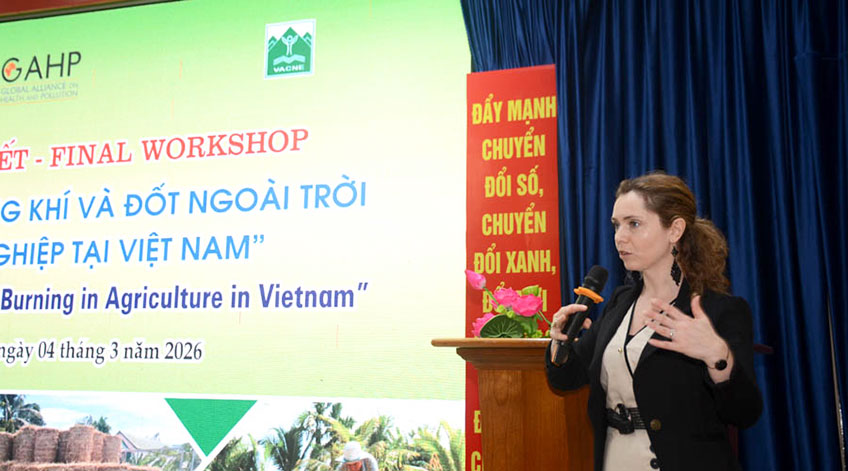
Ms. Adetokunbo Adekunbi Folasade Akinseye, Head of the DEFRA Delegation, and Ms. Maria Paola Lia, Executive Director of GAHP, delivered welcome remarks.
Speaking at the workshop, Ms. Maria Paola Lia highly appreciated VACNE’s evidence-based approach and the close integration between research – policy – and community. The DEFRA representative also recognized this as an effective cooperation model that could share experiences with many countries facing air pollution from agricultural activities.
The workshop received more than 10 thematic reports and dozens of discussion comments, focusing on the scientific basis, practical applicability, and scalability of the pilot models. Many delegates emphasized the need to integrate research results into sustainable agricultural development strategies and local-level climate change response action plans.

Delegates take a commemorative photo
On this occasion, the Organizing Committee launched the “Environmental Health” Network, chaired by Prof. Dr. Meritorious Teacher Dang Kim Chi. The network aims to strengthen connections among scientists in the fields of environment, healthcare, and related sectors; promote interdisciplinary research; and propose policies to protect community health from pollution risks.
Concluding the workshop, Dr. Nguyen Ngoc Sinh affirmed that minimizing open burning and the use of plant protection chemicals is an urgent requirement to protect the environment, public health, and biodiversity. In the coming time, VACNE will continue to cooperate with partners both domestically and internationally to replicate effective models, integrate research results into local action plans, and contribute to building green, low-emission agriculture while moving toward clean air for future generations.
Source: VACNE
 Environmental news
02/03/2026
Environmental news
02/03/2026INTERNATIONAL EXPERTS DISCUSS SOLUTIONS TO CONTROL POLLUTION IN SOUTHEAST ASIA
On the morning of March 2, 2026, in Ho Chi Minh City, the Vietnam Association for Conservation of Nature and Environment (VACNE), in coordination with the Global Alliance on Health and Pollution (GAHP), organized the Regional Pollution Forum (RPF) with the theme “Addressing Pollution to Improve Community Health.” The forum took place over two days, […]
 Environmental news
06/03/2026
Environmental news
06/03/2026SCALING UP THE GREEN AGRICULTURE MODEL: LESSONS FROM THOSE WHO SUCCEEDED
After the project “Air Pollution and Open Burning in Agriculture in Vietnam,” implemented by GAHP in collaboration with VACNE with funding from Defra, alternative models to open burning in agriculture in Vietnam have demonstrated that rice straw is not “waste” that needs to be discarded, but rather a resource capable of generating economic and environmental […]
 Environmental news
06/03/2026
Environmental news
06/03/2026FROM SMOKE AND DUST TO A “CLEAR” SKY
Burning rice straw after harvest used to be a common practice in many rural areas of Vietnam, but it causes numerous environmental and health consequences. Since 2022, the model “limiting open burning of agricultural residues” has been piloted by the Global Alliance on Health and Pollution (GAHP), in coordination with the Vietnam Association for Conservation […]