FROM SMOKE AND DUST TO A “CLEAR” SKY

Burning rice straw after harvest used to be a common practice in many rural areas of Vietnam, but it causes numerous environmental and health consequences. Since 2022, the model “limiting open burning of agricultural residues” has been piloted by the Global Alliance on Health and Pollution (GAHP), in coordination with the Vietnam Association for Conservation of Nature and Environment (VACNE), with the aim of changing farming habits and promoting sustainable agriculture. After three years (2022–2025), the model has shown clear positive changes in the participating localities.
Starting from the smoky fields
In many rice-growing provinces, especially in delta regions, burning rice straw after harvest was once considered the fastest solution to clean the fields. However, the thick smoke and dust from burning straw not only affect traffic visibility but also contribute to increasing air pollution in rural areas and nearby urban centers.

After each harvest season, farmers still often burn rice straw to quickly clear the fields.
After each harvest, thousands of hectares of fields are burned simultaneously, releasing large amounts of CO2 and other pollutants into the environment. In addition, burning straw removes a valuable source of organic matter, causing farmland to become increasingly nutrient-poor and crops to grow less effectively. Recognizing the urgent need to change the way straw is handled after harvest, a project funded by the Department for Environment, Food & Rural Affairs of the United Kingdom (Defra) has coordinated with technical agencies and local authorities in Vietnam to implement alternatives to open burning. The goal is to help farmers adopt more beneficial solutions for agricultural development and environmental protection, such as composting straw into organic fertilizer, using it as a substrate for mushroom cultivation, using it as livestock feed, or utilizing it for other economic purposes.
In the early years of implementation, the biggest challenge was not technical but rather changing the long-standing habits of farmers. Many still believed that burning straw was the quickest and most convenient method, while other approaches required more time and effort.
To address this, the project focused on communication and raising community awareness. Training programs, workshops, and communication activities were organized in many localities, helping farmers better understand the harmful impacts of burning straw and the benefits of more sustainable handling methods.

From the project, rice straw has been utilized to create alternative solutions that generate income in agriculture.
At the same time, many practical models have been established directly in local areas so that farmers can observe and learn firsthand. When they see that rice straw can become a source of organic fertilizer for rice fields, a material for mushroom cultivation, or even an additional source of income, many farmers begin to change their perception of agricultural by-products that were previously considered “waste.”
After more than three years of implementation, the model has attracted the participation of farmers from more than 20 out of 34 provinces and cities nationwide. This broad participation shows that the issue of burning rice straw is not just the story of a few localities but a shared concern of the agricultural sector and the wider community.
Increasing participation from farmers
Not only stopping at participating in training programs, many farmers have also become pioneers in applying sustainable rice straw treatment methods in their localities. From the initial small-scale models, effective practices have gradually spread to other farming households in the same area.

Farmers get acquainted with alternatives to open burning such as using microorganisms for fields
After more than three years of implementation, the project has recorded many positive results. In many pilot localities, the number of fields where rice straw is burned has decreased significantly compared to before. Instead, rice straw is collected and reused in various ways. Utilizing rice straw not only helps reduce greenhouse gas emissions but also contributes to improving soil fertility, lowering the cost of chemical fertilizers, and creating additional sources of income for farmers. More importantly, community awareness about the environmental impacts of burning rice straw has clearly changed.
For the pilot localities, the model has also brought valuable lessons on how to organize, mobilize communities, and implement sustainable agricultural solutions. The three-year journey of the “no-burning” model shows that changing a long-standing farming habit is not easy, but it is entirely achievable when there is close coordination between local authorities, professional organizations, and the farming community.

Farmers’ awareness has been enhanced through training sessions and workshops held locally.
In the coming period, experiences and lessons learned from pilot localities will continue to be compiled, managed, and widely shared. Effective models will be disseminated and replicated, while solutions that are not yet suitable will be adjusted to better match real conditions. The ultimate goal is not only to minimize the burning of rice straw but also to build a circular agricultural ecosystem, where agricultural by-products are utilized to the fullest instead of being treated as waste.
From smoke and haze to clear skies
One of the key factors contributing to the success of the model is a diverse and continuous communication strategy. Throughout the implementation process, more than 175 news articles, reports, and thematic publications have been produced and published across media channels. In addition, 18 awareness-raising communication videos have been developed and widely distributed, helping bring the message of agriculture without rice straw burning closer to the community. Radio programs and news bulletins have also been implemented to reach farmers in rural areas, where traditional media still plays an important role.

The project spreads core values and promotes awareness within the community to help develop sustainable agriculture in Vietnam.
On online platforms, the communication campaign has reached nearly 200,000 people, showing growing public interest in the issue of air pollution caused by rice straw burning. In addition, before the project was implemented, more than 3,300 survey responses were collected from different groups of participants to assess the current situation and the community’s awareness. These data helped the project design activities that are suitable for each locality and each target group.
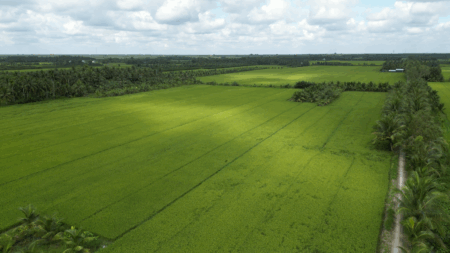
It can be seen that three years is not a very long period of time, but it is enough to demonstrate that positive changes are gradually taking shape in the fields. From rice fields once covered in smoke and dust after harvest, more and more places are shifting to farming methods that are more environmentally friendly.

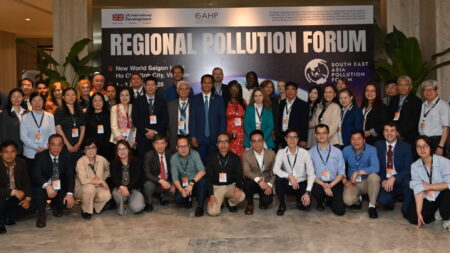
Delegates take a commemorative photo at the project’s final workshop
The journey from smoky haze to clear skies is not only the story of a project, but also proof of the power of cooperation and change within the community. When farmers become the center of solutions, small initiatives in the fields can contribute to creating big changes for the environment and the future of Vietnam’s agriculture.
sos
 Environmental news
02/03/2026
Environmental news
02/03/2026INTERNATIONAL EXPERTS DISCUSS SOLUTIONS TO CONTROL POLLUTION IN SOUTHEAST ASIA
On the morning of March 2, 2026, in Ho Chi Minh City, the Vietnam Association for Conservation of Nature and Environment (VACNE), in coordination with the Global Alliance on Health and Pollution (GAHP), organized the Regional Pollution Forum (RPF) with the theme “Addressing Pollution to Improve Community Health.” The forum took place over two days, […]
 Environmental news
04/03/2026
Environmental news
04/03/2026INTERNATIONAL WORKSHOP SUMMARIZING THE PROJECT “AIR POLLUTION AND OPEN BURNING IN AGRICULTURE IN VIETNAM”
On the morning of March 4, 2026, in Ho Chi Minh City, with the support and permission of the Ministry of Agriculture and Environment, the Vietnam Association for Conservation of Nature and Environment (VACNE) coordinated with partners to organize the International Workshop summarizing the project “Air Pollution and Open Burning in Agriculture in Vietnam.” The […]
 Environmental news
06/03/2026
Environmental news
06/03/2026SCALING UP THE GREEN AGRICULTURE MODEL: LESSONS FROM THOSE WHO SUCCEEDED
After the project “Air Pollution and Open Burning in Agriculture in Vietnam,” implemented by GAHP in collaboration with VACNE with funding from Defra, alternative models to open burning in agriculture in Vietnam have demonstrated that rice straw is not “waste” that needs to be discarded, but rather a resource capable of generating economic and environmental […]