WHEN RURAL WOMEN BECOME “SKY GUARDIAN”
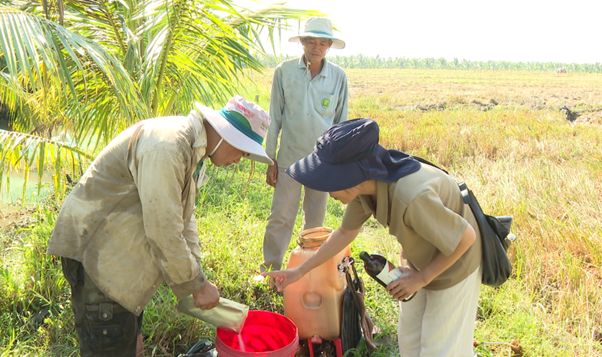
In purely agricultural rural areas, where life is closely tied to the farming seasons, the idea of “keeping the sky clear” — without straw smoke or the burnt smell after each harvest seems like something big and far away. But in reality, that change begins with very ordinary people, especially women, elderly farmers who spend their days attached to the fields and the village, quietly deciding the farming methods for their entire families and communities…
The woman who decides the whole crop season
Mrs. Nguyen Thi Dung, a farmer from An Thanh hamlet, An Truong commune (Vinh Long), is one of those people. In her family, both she and her husband are farmers, but she is the one who closely monitors each rice crop and every small change in the field. “When you farm, you have to pay very close attention: Watch the weather, the soil, the seeds, and then figure out what to do so the rice grows well and yields a high harvest,” Mrs.Dung shared.
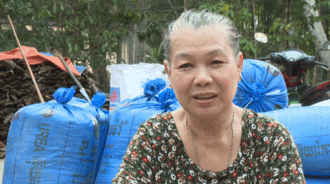
Mrs. Nguyen Thi Dung – a farmer from An Thanh hamlet, An Truong commune (Vinh Long province).
She once gave up the habit of burning rice straw and switched to using microbial preparations across different crop seasons to protect the environment and safeguard the health of herself, her family, and the community. She shared: “Some seasons bring profit, others just barely cover our meals, especially when rice prices drop during the summer – autumn crop. But what keeps me committed to using microbes isn’t just about short-term profit or loss – it’s that I no longer have to burn the straw. After spraying the microbes, the rice stubble decomposes very quickly and becomes nutrients for the soil. We can sow the next crop right away and save a lot on fertilizer.”
According to Mrs. Dung, if straw is not burned, some households collect it to feed cattle, which also helps save resources, but it does not create as clear an economic benefit or soil improvement as treating it with microbial products directly in the field.
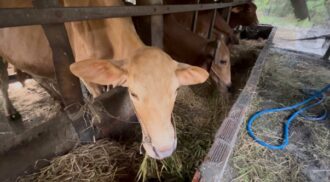
Farmers in Vĩnh Long often handle rice straw after harvest by using it as livestock feed.
Notably, at first she was very worried: “Because if the spraying didn’t work, it would mean losing the entire plot of rice, the whole crop.” But the encouragement from the local commune authorities and her trust in the programs and policies implemented by the State made her decide to give it a try.
And the result surprised her: the straw decomposed so quickly that it was “something she had never seen before.” Previously, she had to wait more than a month before daring to sow again, fearing that the straw had not fully decomposed, which could easily lead to weedy rice and force the use of herbicides. Now, however, the rice grows lush and green; there is almost no mixed rice or weedy rice, and there is no need to use chemical-based plant protection products. “You only realize it after doing it; you only dare to keep doing it after you believe in it; and only by continuing can it spread for others to follow,” Ms. Dung replied with a smile.
It was also she the woman of the family and a woman of the fields alongside fellow farmers who made the decision to work with microorganisms, abandoning habits that negatively affect the environment and the health of the wider community.
Microorganisms: From research to the Fidel
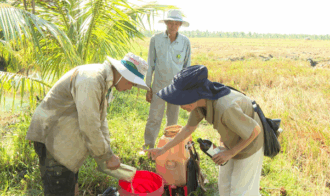
VACNE members in the Project are guiding farmers in the use of microbial preparations
The type of microbial inoculant that many farmers in Vĩnh Long have been using recently is not a mass-market commercial product, but a biological preparation researched and developed by Nguyen Tat Thanh University. It is being piloted within the framework of a project by the Global Alliance on Health and Pollution (GAHP), in collaboration with the Vietnam Association for Conservation of Nature and Environment (VACNE), with funding from the UK Department for Environment, Food & Rural Affairs (Defra).
Unlike many technical solutions that are difficult to access, this microbial preparation is designed to suit various farming conditions. Both large-scale and small holder farms can use it easily and at low cost. It helps quickly decompose rice straw residues directly in the field, reducing the need to burn straw. At the same time, it adds nutrients to the soil, reducing dependence on chemical fertilizers and crop protection chemicals.
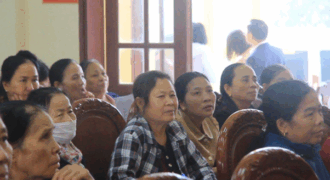
Women and farmers in Khánh Trung commune (Ninh Bình) at an environmental training session being held.
For farmers, the benefits are not only in saving input costs and shortening the preparation time for the next crop, but also in reducing health risks from rice straw smoke and improving working conditions in the fields. In particular, this model is creating a clear impact on women and the elderly: women can proactively access techniques, participate in training, and become people who guide the community in return; older people are less exposed to smoke and dust, and the work of handling rice straw becomes lighter, no longer dependent on labor-intensive and risky traditional burning methods…
Women – the “transit station” of community knowledge
In Khanh Trung commune (Ninh Bình), Mrs. Nguyen Thi Phuong – Head of the Women’s Union branch of Hamlet 51 plays the role of a connector and a disseminator. “Women both earn a living and take care of the family. And precisely because of that, if women understand and change their mindset about protecting the environment and protecting health, the whole family will change along with them,” Mrs. Phuong said.
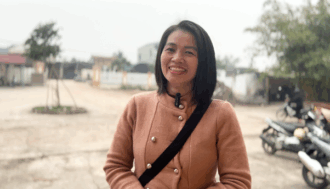
Mrs. Nguyen Thi Phuong – Head of the Women’s Union Branch of Hamlet 51, Khánh Trung Commune – shares approaches to supporting vulnerable groups.
Therefore, she regularly participates in training courses on agriculture and the environment organized by local authorities and various organizations. In addition, she also studies on her own through social media and then passes the knowledge on to other members, especially women who are busy with farm work, have difficult circumstances, or have limited opportunities to access information.
According to Ms. Phuong, vulnerable groups such as women, the elderly, single mothers, and people with disabilities often face many barriers in accessing new knowledge. Without someone to “support” them, it is very difficult for them to participate in decisions related to the environment and livelihoods. She hopes that the government and leadership at different levels will create more space for vulnerable groups to speak up and take part in decision-making, especially in localities that mainly depend on agriculture.
Forms of communication that feel familiar and accessible such as commune loudspeakers, mobile vehicles equipped with speakers, or in-person training sessions are considered by her to be the most effective: “People trust the authorities; if the message is accurate, repeated often, and delivered consistently, people will follow.”
When women and the elderly become the “guardians of the sky”
Mrs. Bui Thi Tho, Head of the Farmers’ Union Branch of Hamlet 10, Kim Đông Commune (Ninh Bình), is also someone who has directly witnessed changes in community awareness. In the past, after harvest, burning rice straw in the area where she lives was almost a habit. But after many rounds of communication and training, people have come to better understand its harmful impacts on the environment and health.
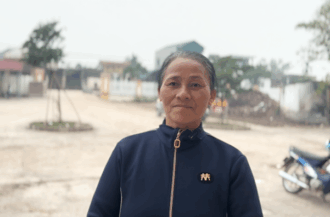
Mrs. Bui Thi Tho, Head of the Farmers’ Association branch of Hamlet 10, Kim Dong commune (Ninh Binh), shares methods to replace the burning of rice straw.
As someone working in the healthcare sector, Mrs. Thơ feels this even more deeply: “Rice straw smoke affects the lungs; some people in the village have chronic pneumonia, even lung cancer.” Currently, she and many households have switched to collecting straw to sell, which both brings additional income and reduces field burning. However, she had not previously had access to microbial products and only learned about them through a recent training course.
She believes that for microbial solutions to truly become a long-term alternative, synchronized support is needed. “Irrigation water is shared and the fields are close together. If some people use it and others don’t, it’s very difficult to implement it collectively. Therefore, authorities need to provide equal support and clear guidance so that people feel confident to follow,” Mrs. Thơ said. She also frankly pointed out barriers related to cost and knowledge: if officials only distribute microbial products without specific instructions, farmers will find it difficult to adopt them. But if there is proper training and support for trials, she is willing to apply the new method.
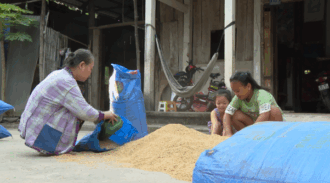
Vulnerable groups have the right to participate in decision-making that contributes to building a greener life.
Looking at the stories from Vĩnh Long and Ninh Bình, it becomes clear that women and the elderly are not merely beneficiaries; they are the core force in promoting, practicing, and sustaining smart, environmentally friendly agricultural models.
They are the ones who decide how farming is done, who spread information within the community, and who patiently persuade each household and each family. When given opportunities, knowledge, and appropriate support, they become silent “guardians of the sky,” keeping the fields free of smoke, the sky clear and blue, and livelihoods more sustainable. And perhaps the journey toward green agriculture would move much faster if it began with these very ordinary people.
SOS
 Environmental news
02/03/2026
Environmental news
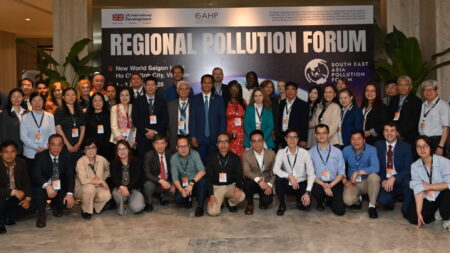
02/03/2026INTERNATIONAL EXPERTS DISCUSS SOLUTIONS TO CONTROL POLLUTION IN SOUTHEAST ASIA
On the morning of March 2, 2026, in Ho Chi Minh City, the Vietnam Association for Conservation of Nature and Environment (VACNE), in coordination with the Global Alliance on Health and Pollution (GAHP), organized the Regional Pollution Forum (RPF) with the theme “Addressing Pollution to Improve Community Health.” The forum took place over two days, […]
 Environmental news
04/03/2026
Environmental news
04/03/2026INTERNATIONAL WORKSHOP SUMMARIZING THE PROJECT “AIR POLLUTION AND OPEN BURNING IN AGRICULTURE IN VIETNAM”
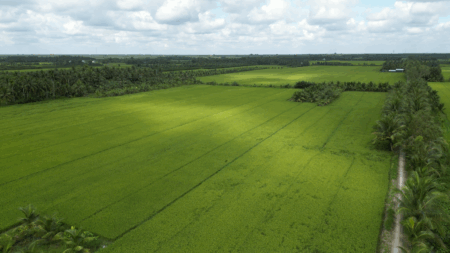
On the morning of March 4, 2026, in Ho Chi Minh City, with the support and permission of the Ministry of Agriculture and Environment, the Vietnam Association for Conservation of Nature and Environment (VACNE) coordinated with partners to organize the International Workshop summarizing the project “Air Pollution and Open Burning in Agriculture in Vietnam.” The […]
 Environmental news
06/03/2026
Environmental news
06/03/2026SCALING UP THE GREEN AGRICULTURE MODEL: LESSONS FROM THOSE WHO SUCCEEDED
After the project “Air Pollution and Open Burning in Agriculture in Vietnam,” implemented by GAHP in collaboration with VACNE with funding from Defra, alternative models to open burning in agriculture in Vietnam have demonstrated that rice straw is not “waste” that needs to be discarded, but rather a resource capable of generating economic and environmental […]